

Lessons From the Malibu Deployment: Power When the Grid and the Roads Are Gone
When wildfires tore through Malibu in early 2025, power lines came down, evacuation routes became one-way corridors, and fuel trucks could not get through. For emergency responders, contractors, and relief coordinators still operating in or near the fire zone, that combination created a problem that a standard diesel generator cannot solve: no grid, no roads, and no way to refuel.
Sun For Rent, the rental fleet sister company of Mobile Solar Power, deployed mobile solar generators into the Malibu response. The mission brief was simple and unambiguous: deliver clean, reliable energy where it was needed most. The deployment worked because the units carried their fuel with them in the form of sunlight, and the sun did not require a road.
This article examines what that deployment teaches about preparing for the next disaster, and why teams that wait until a fire is burning to think about power options run out of good choices fast.
When Fuel Logistics Collapse, Solar Becomes the Only Option
Emergency managers understand cascading infrastructure failure in theory. Wildfire response makes it concrete. Roads get closed for firefighter access and public safety. Fuel tankers cannot reposition when evacuation orders are active. And even when a fuel delivery is theoretically possible, the priority queue for those trucks belongs to fire apparatus, not to a contractor’s generator.
Diesel generators are entirely dependent on that supply chain. By Sun For Rent’s estimates, a diesel rental runs roughly $1,500 per month per shift and burns about one gallon per hour under normal conditions. Under disaster conditions, that per-gallon cost becomes irrelevant because the gallon is simply unavailable. A unit sitting empty is worse than no unit at all: it creates a false expectation of power that someone is counting on.
A solar generator for disaster response carries no such dependency. The panels harvest energy as long as the sun rises, which it will do regardless of road closures or fuel allocation decisions made 50 miles away. That is not a minor convenience. In a multi-day deployment with cut-off logistics, it is the difference between continuous operations and a generator that goes quiet on day two.
What Sun For Rent Brought to Malibu
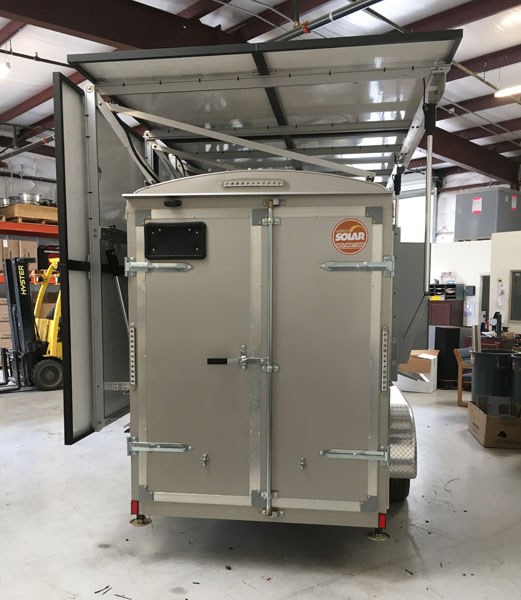
The Malibu deployment drew on the same trailer-mounted platform that Mobile Solar has been building in Atascadero, California for over 20 years. Every unit rolls on a road-legal trailer, deploys with push-button panel extension, and starts producing power without permits, fuel hookups, or a technician on site.
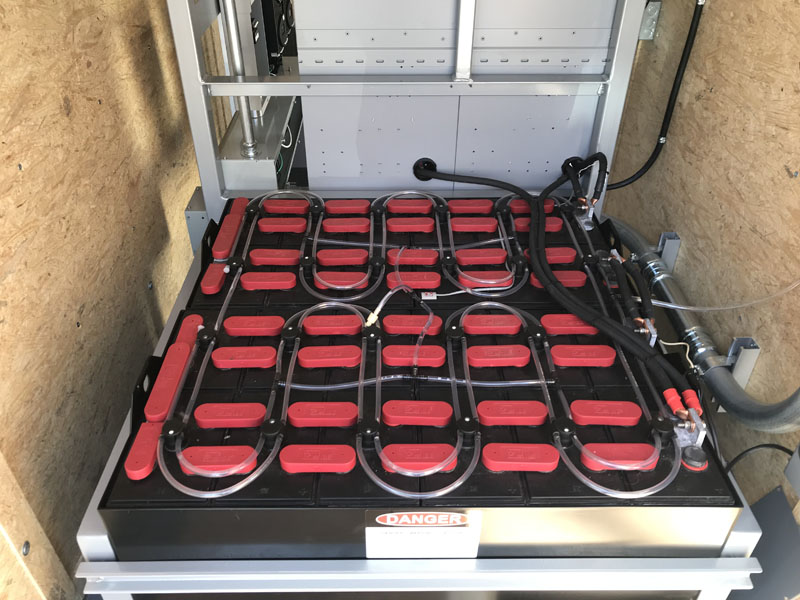
The MS Series units in this class of deployment typically produce between 15 and 21 kilowatt-hours per day depending on configuration, with battery banks ranging from 20 kWh (MS-200) up to 70 kWh (MS-432). The MS-425, the most popular configuration, delivers 16 kW rated output, a 60 kWh battery, and 21 kWh of daily solar harvest. That covers lighting, communications equipment, HVAC in a command trailer, and tool charging simultaneously, with battery reserve for cloudy periods or overnight operation.
For deployments requiring heavier continuous loads, the M1 solar generator steps up to 16 kW rated output, 70 kWh of battery storage, and 33.94 kW instantaneous surge capacity. It is built to military standards for extreme durability. The U.S. Army ran an M1 at Fort Irwin for 45 consecutive days of continuous operation. That track record matters when the question is not “will it work on a nice day” but “will it still be running on day 30 of a wildfire response.”
Remote Monitoring Means One Less Person in the Field
One of the underappreciated advantages of a trailer mounted solar generator during a disaster response is what it does not require. Every Mobile Solar unit includes a cellular modem that transmits real-time load, output, and battery data to any device with a browser. The operations team can watch the state of charge from the incident command post or from a desk 200 miles away.
That matters in a wildfire context because access zones shift constantly. A unit deployed at a staging area may become temporarily inaccessible as fire lines move. With cellular remote monitoring, the team knows whether the battery is at 80% or 8% without sending anyone to check. They can make decisions about load shedding or repositioning based on real data rather than assumptions. For diesel, “how much fuel is left” requires someone physically present. For Mobile Solar, it is a number on a screen.
The same remote diagnostics capability that construction site managers use to eliminate daily fuel checks becomes a genuine operational advantage when physical site visits are restricted by emergency conditions.
The Credibility Question: Who Has Done This Before
Emergency managers evaluating power options for the first time during a crisis face a compressed timeline and incomplete information. The right question to ask a vendor is not “can your equipment handle this” but “who has used it in conditions like this, and for how long.”
Mobile Solar’s verified client list includes the U.S. Navy, U.S. Air Force, U.S. Army, NASA, EPA, USDA, Bureau of Land Management, and the San Luis Obispo County Sheriff. These are organizations that do not accept equipment on faith. They test, they evaluate, and they deploy again when something performs. The Army’s 45-day Fort Irwin continuous operation record is a data point, not a marketing claim.
On the commercial side, the client list includes Phillips 66, Verizon, Lockheed Martin, and Parsons, which ran a two-year military project on Mobile Solar equipment. These organizations operate in remote, demanding, and sometimes austere environments where generator failure is not an inconvenience but a mission problem. Mobile Solar has been their answer for those missions across 6 continents.
The Window Before Fire Season Closes
The Malibu deployment demonstrated that mobile solar works under real disaster conditions. It also demonstrated something that is easy to overlook: the units were already in Sun For Rent’s fleet before the fires started. Equipment that is staged, configured, and maintained before an event is available within hours of a call. Equipment that is ordered during an emergency is available whenever the supply chain can deliver it, which in a widespread disaster may be weeks.
Fire season in California now effectively runs year-round, with peak risk shifting later into the fall and winter as drought conditions persist. Emergency managers, county agencies, utility contractors, and critical facility operators who depend on grid power during normal operations should be evaluating backup and emergency power now, not after a red-flag warning is issued.
The specific questions worth answering in advance: What is the rated output and battery capacity needed to keep critical loads running for 72 hours? Can the equipment be positioned where road access is likely to remain available? Is there an operator on staff who knows the push-button deployment sequence, or does a technician need to be on site?
Mobile Solar’s off-grid solar generator line covers outputs from 3.6 kW to 16 kW on standard trailer platforms, with supplemental arrays available to scale output for larger installations. Configurations are built to order in Atascadero, which means lead time is a real planning factor. Talking to the team before fire season is not a procurement formality. It is the difference between having equipment staged and not having it.
Preparing Now: A Practical Framework
Pre-season preparation for disaster power follows a short checklist. Assess the critical load first: lighting, communications, medical equipment, refrigeration, and HVAC have different draw profiles, and the right unit size depends on what must stay on, not what would be nice to have.
Match the battery bank to the expected gap. If grid restoration takes 24 hours in most events but 72 hours in severe ones, size for the 72-hour scenario. The MS-422 and MS-425 carry 50 to 60 kWh of storage with 21 kWh of daily solar recharge. A site pulling 5 kW continuously can cover a 24-hour gap on battery alone and recharge the next day on sun.
Factor in scalability. Mobile Solar units accept supplemental SA arrays that add up to 38 kWh of daily harvest. If the base deployment proves undersized during an event, an SA array can be towed to the same location. Multiple units can also be deployed in parallel. Scalability after deployment is an operational safety net that fixed installations cannot offer.
The disaster recovery page at mobilesolarpower.net is the right starting point for emergency-specific applications. For a detailed conversation about a specific site and load profile, the team at (805) 466-1006 can work through the numbers before any commitment is required.
Malibu will not be the last wildfire. The lesson it offers is available now, at no cost, to anyone willing to plan before the smoke column appears on the horizon.
—
Frequently Asked Questions
How quickly can a mobile solar generator be deployed for disaster response?
Mobile Solar units are trailer-mounted and road-legal, so they can be towed to a site and producing power within minutes of arrival. Panel deployment is push-button, with no permits required and no fuel hookup needed. Sun For Rent’s Malibu deployment placed operating units at the response site without the setup time that a diesel installation or a permanent generator would require.
What happens to solar output when skies are smoky or overcast during a wildfire?
Solar panels generate power from light, not heat, and they continue producing during partial cloud cover or haze, though at reduced output. The battery storage banks on Mobile Solar units, ranging from 20 kWh on the MS-200 to 70 kWh on the MS-432, provide reserve capacity to bridge reduced-harvest periods. For extended low-sun conditions, an optional Honda EU7000 hybrid backup can maintain charge without relying on fuel delivery infrastructure.
Can a solar generator keep communications and command equipment running overnight?
Yes. The battery banks on Mobile Solar units are sized for overnight and multi-day autonomy. The MS-425, Mobile Solar’s most popular configuration, carries 60 kWh of storage and delivers 16 kW of continuous rated output. Communications equipment, lighting, and command trailer HVAC are well within that envelope. Cellular remote monitoring lets operators track the state of charge from off-site so they can plan load management without visiting the unit.
—
About Mobile Solar
> Mobile Solar is America’s original mobile solar generator manufacturer, designing and building every trailer mounted solar generator in-house in Atascadero, California for over 20 years. Mobile Solar delivers clean, quiet, fuel-free power for construction sites, off-grid and remote operations, government, and military applications nationwide. Request a quote at mobilesolarpower.net or call (805) 466-1006.
—