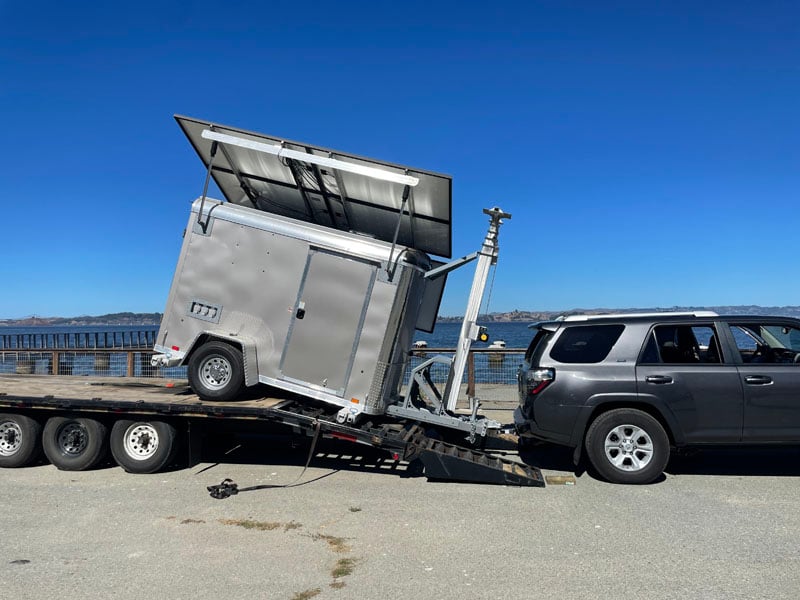


Off-Grid Solar Generators for Remote Sites
Some of the most critical work on earth happens in places the power grid simply does not reach. Wind energy developers stake out ridgelines for months before placing a single turbine. Telecom companies need full-time power on tower sites with no utility connection in sight. Astronomical researchers, oil and gas survey teams, and military logistics units operate in deserts, forests, and high plains where a diesel fuel run can mean hours of driving over rough terrain. For every one of these applications, the off-grid solar generator has moved from a novelty to a practical first choice.
The Problem with Fuel at Remote Sites
Diesel has served remote operations for decades, but it has never been a clean solution. By Sun For Rent’s cost analysis, a diesel generator rental runs roughly $1,500 per month per shift and burns approximately one gallon of fuel per hour. Multiply that across a multi-month deployment with double shifts and the logistics cost alone becomes a significant project line item. Add the oil changes, the maintenance hours, the noise that interferes with sensitive instruments, and the exhaust fumes that compromise air quality at the work site, and diesel starts looking like an operational liability rather than a convenience.
The logistical burden is sharpest at truly remote sites. When a wind assessment trailer is parked on a ridge two hours from the nearest paved road, every fuel delivery requires a full truck run. When a telecom repeater is mounted on a coastal bluff, keeping a diesel genset fed means scheduling service visits at intervals that compress crew time and inflate costs. An off-grid solar generator with adequate battery storage eliminates those runs entirely.
Wind and Environmental Research: Sit and Stream
Mobile Solar has built modified MS-series units for wind observation deployments that illustrate the argument clearly. In the wind industry, LIDAR-equipped trailers are placed in remote locations being considered by wind farm developers. The systems sit for months, sometimes more than a year, measuring wind speeds at different altitudes and streaming data to the developer in real time. Because the batteries are maintenance-free, service visits are not required beyond an occasional panel washdown. Most of those trailers are not visited by a technician more than once a year.
That kind of deployment makes every diesel-dependent alternative impractical. Scheduling quarterly fuel runs to remote ridgelines, coordinating with landowners, and absorbing the labor cost of each visit erases a large portion of the fuel savings. A solar-plus-storage unit with cellular remote monitoring converts what would have been a field-maintenance headache into a dashboard check.
Telecom and Data Sites
Telecom infrastructure increasingly extends to locations where grid service is either unavailable or prohibitively expensive to establish. Mobile Solar has built custom heavy-duty telecom solar power units specifically for data and telecom sites in dense metro markets where grid access is complicated. Custom MS-375 units manufactured for telecom deployments in the Los Angeles area carried 32 kW rated inverter output with surge capacity to 64 kW, 80 kWh battery banks, and native solar arrays designed to accept up to 20 kW DC from supplemental SA-series rolling arrays.
Those numbers are unusual for a trailer-mounted platform, but they reflect the actual power demands of telecom and data hardware. The underlying principle is the same across scales: a battery bank large enough to ride through nights and overcast days, a solar array sized to replenish it, and a monitoring system that lets the operator watch performance from any device. For sites that run 24/7 and cannot tolerate downtime, the cellular remote monitoring built into every commercial solar generator Mobile Solar builds is not a convenience feature. It is an operational necessity.
Oil, Gas, and Survey Operations
Survey, seismic, and pipeline monitoring work shares the same profile as wind assessment: equipment parked in open country for extended periods, logging data or providing communications infrastructure to a crew that needs reliable power without a generator attendant on site. Mobile Solar’s AN series (AN-X129 and AN-R140) is built specifically for extreme environments, with stackable, overhead-liftable configurations designed to move in and out of difficult terrain. Detailed specs are available by request for project-specific requirements, but the core specification remains: weatherproof, lockable, cellular-monitored, and fuel-free.
The optional Honda EU7000 hybrid backup preserves the fuel-free primary operation while giving site managers a safety net for extended cloudy weather without requiring a full-size diesel genset on standby. The generator only runs when the solar bank genuinely needs supplemental input, so fuel consumption over a long deployment remains a fraction of what a diesel-primary setup would require.
Remote Research and Off-Grid Operations
Not every off-grid deployment fits the oil-field or telecom mold. Mobile Solar’s track record includes a genuinely memorable application: a custom MS-series unit built for a couple who travel full-time with a collection of reflector and refractor telescopes, conducting free public astronomy sessions at schools and national parks across the country. The challenge was climate control for sensitive optics during boondocking in locations without electrical hookups. A gas generator was considered but rejected because constant refueling and noise would have degraded the star-gazing experience. The MS-325, with its 12 high-efficiency solar panels and large battery bank, powers the air conditioning units silently and without fuel.
The principle here scales directly to scientific field research. Remote biological monitoring stations, atmospheric sensing arrays, university field camps, and conservation sensor networks all share the same requirement: sustained power at a site that is far from fuel and far from a utility line. Quiet operation also matters in research contexts. Noise from a diesel generator interferes with acoustic monitoring, disturbs wildlife, and compromises data integrity in ways that are difficult to quantify until the data comes back corrupted.
Cellular Monitoring Eliminates the Fuel-Check Visit
Every trailer mounted solar generator Mobile Solar builds includes a cellular modem that delivers real-time load, output, and usage data to any device. An operator can check state of charge, daily harvest, and load draw from a laptop or phone without leaving the office. When anomalies appear, remote diagnostics narrow the cause before anyone drives to the site. When everything is running normally, there is simply nothing to visit.
The contrast with diesel management is direct. Diesel requires scheduled fuel checks even when the generator is running well, because an empty tank at a remote site stops all work instantly. A solar generator for remote monitoring with adequate battery reserves and cellular telemetry replaces that scheduled-visit overhead with a dashboard glance. Over a year-long LIDAR deployment, the accumulated time savings are substantial.
Cold-Weather Performance at Remote Northern Sites
One of the persistent objections to solar power for remote operations is winter performance at northern latitudes. The objection is understandable but overstated. According to mobilesolarpower.net’s own cold-weather analysis, solar panels generate electricity by absorbing sunlight, not heat. Cold temperatures can actually improve panel efficiency, with panels capable of producing up to 110% of their rated output in cold conditions. Net annual output at northern sites tends to be comparable to sunnier southern ones because longer summer days compensate for shorter winter days.
For cold-weather deployments where battery charging in sub-freezing temperatures is a design requirement, Mobile Solar’s M1A1 platform is designed to accommodate self-heating LiFePO4 battery technology, which includes self-heating cells that keep internal battery temperature around 1 to 5 degrees C. That allows safe charging down to approximately -20 C (-4 F), addressing the hard limitation of standard LiFePO4 chemistry that prevents charging below freezing. Any project operating in Arctic or alpine conditions should discuss battery chemistry options with Mobile Solar directly, as configuration varies by deployment requirement.
Proven at Scale
The client list Mobile Solar can point to for remote and off-grid deployments goes well beyond single-unit pilots. NASA, the EPA, the U.S. Army (with documented 45 consecutive days of continuous operation at Fort Irwin, California), Lockheed Martin, Verizon, Tetra Tech, and Parsons (on a multi-year military project) are among the organizations that have trusted Mobile Solar’s generators in demanding field conditions. The fact that these organizations return for multiple units and extended contracts reflects performance in actual remote deployments, not controlled demonstrations.
Phillips 66, Leidos, and Tetra Tech bring oil-and-gas and engineering survey credentials. Verizon reflects telecom and communications infrastructure. The USDA and Bureau of Land Management represent the federal land-management and research context where remote power requirements are routine. Taken together, the client list describes an organization whose remote-site deployments are not experiments. They are production infrastructure.
Sizing for the Mission
The right unit for a remote deployment depends on the load profile, the solar resource at the deployment latitude, and the required days of autonomy when solar input is minimal. Mobile Solar’s current lineup covers a wide range. The SRX-6 starts at 3.6 kW rated with 20.48 kWh of LiFePO4 storage, scaling to the SRX-15 at 8 kW continuous with 40.96 kWh. The MS-425, the most popular MS-series unit, delivers 16 kW with 60 kWh and 21 kWh estimated daily harvest. The M1 reaches 16 kW rated output with 70 kWh of battery storage and 33.94 kW instantaneous capacity, built to military standards for extreme durability. All units are engineered and manufactured in-house in Atascadero, California.
For loads that exceed a single unit’s capacity, the M1 solar generator and MS-series units scale with SA-series supplemental solar arrays or parallel unit deployments. Mobile Solar’s engineers size every system to the specific load and site before a unit leaves the factory. Pricing is quote-based per configuration. The right starting point for any remote project is a direct conversation with the Mobile Solar team.
—
Frequently Asked Questions
How long can a Mobile Solar unit operate without any solar input? Battery autonomy depends on the unit and the connected load. The MS-425, for example, carries 60 kWh of battery storage and is rated at 16 kW output. Under a moderate continuous load, the battery bank provides overnight autonomy and, in many deployments, rides through overcast days without supplemental power. Mobile Solar engineers size battery capacity to the load and expected solar resource for each deployment. For any site where extended cloudy-weather autonomy is critical, the optional Honda EU7000 hybrid backup provides a fuel-based safety net without requiring a separate generator.
Can these units handle year-round remote deployments in cold northern climates? Yes. Solar panels generate power from sunlight, not heat, and can actually operate above rated output in cold temperatures, reaching up to 110% of rated output according to Mobile Solar’s own cold-weather testing data. Net annual production at northern sites is comparable to sunnier southern ones because longer summer days offset shorter winter days. For deployments requiring battery charging in temperatures below 0 C, the M1A1 platform is designed to accommodate self-heating LiFePO4 batteries, which support safe charging to approximately -20 C (-4 F).
What does the cellular remote monitoring include, and do I need a technician on site? Every Mobile Solar unit ships with a built-in cellular modem that delivers real-time state of charge, solar output, load draw, and usage data to any web-connected device. Remote diagnostics are included, allowing the manufacturer to identify and often resolve issues without a site visit. In practice, long-duration remote deployments like the LIDAR wind-assessment trailers Mobile Solar has built are visited by a technician less than once a year. The monitoring system replaces scheduled check-in visits and reduces unplanned downtime.
—
About Mobile Solar
> Mobile Solar is America’s original mobile solar generator manufacturer, designing and building every trailer mounted solar generator in-house in Atascadero, California for over 20 years. Mobile Solar delivers clean, quiet, fuel-free power for construction sites, off-grid and remote operations, government, and military applications nationwide. Request a quote at mobilesolarpower.net or call (805) 466-1006.
—