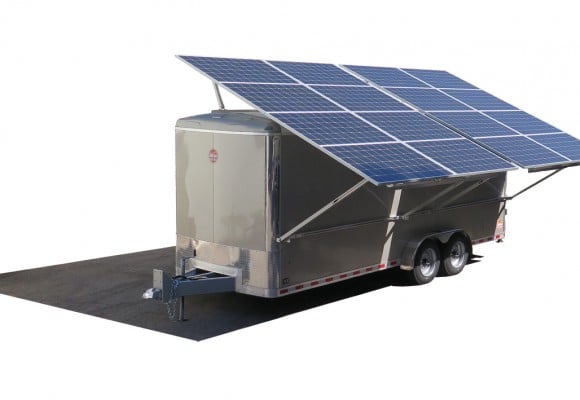


Comparing Our MS-Series Solar Generators: From the MS-150 to the MS-425
The MS-Series is not a single product. It is a family of towable solar power systems built around different power requirements, job types, and operating budgets. If you have been trying to figure out which unit fits your situation, this page walks through what is published about each model and flags the ones where you will need to call us directly for specs.
Why the Range Exists
Not every job has the same power demand. A single-contractor construction site has different needs than a telecom data node running through an emergency or a disaster recovery team that has to operate for weeks without resupply. Rather than push every customer toward one size, the MS-Series was built across a range of configurations so the unit can match the load, not the other way around. That said, the models are not cosmetically different trim levels. The smallest and largest units in the lineup differ by roughly an order of magnitude in output. Choosing the right one matters.
All MS-Series units share the same basic operating premise: solar panels charge a battery bank, an inverter converts that power for practical use, and the whole system rides on a towable trailer that a standard pickup can haul. No fuel runs. No exhaust. No noise. What changes across models is how much of each of those components you get, and how the interior is configured for the specific job you need done.
The MS-150: Compact and Field-Proven
The MS-150 earned its reputation in one of the most demanding real-world tests possible. Seven units were loaded with tools and placed around northern Japan in the weeks following the 2011 tsunami to support disaster recovery efforts. The page documenting that deployment notes the units could “operate around the clock with no fuel input,” which is exactly the kind of reliability you need when standard supply chains are compromised.
Specific electrical specs for the MS-150 are not published on the site. Contact us for specs if battery capacity, inverter rating, or panel configuration are decision factors for your project. What the deployment record does confirm is that the unit is durable, fuel-independent, and built for field conditions where conventional emergency backup power infrastructure may not be available.
The MS-225: High Output in a Small Frame
Mark Motto, a retired air traffic controller on a 42-acre farm in North Carolina, has been running an MS-225 since 2014. His use case covers more ground than most: he charges a Nissan Leaf electric vehicle daily, powers livestock water heaters through freezing temperatures, provides light and heat for chickens, and runs power tools during barn construction. He reports the unit outperformed a 5,500-watt gas generator during the barn project and has driven approximately 20,000 miles using solar energy from it.
The published specs for the MS-225 are specific. Battery capacity is 25 kWh. The page on recharge time uses the MS-225 as its worked example: at 9 kWh of daily solar harvest, an 80% discharge (20 kWh utilized) takes about 2.2 days to recover. On clear days the unit delivers Level 2 EV charging. On overcast days it drops to Level 1. The site describes the MS-225 as the “hot rod” of the lineup, meaning it prioritizes a high-output inverter over raw battery volume. If your load is continuous but moderate, and if physical footprint matters, the MS-225 is the unit to look at first.
The MS-325: Climate-Controlled Interior, Serious Battery Bank
The MS-325 shows up in a profile of John and Brenda Nejedlo, who left their jobs in Wisconsin to travel full time, carrying a collection of large reflector and refractor telescopes. Some of those telescopes stand up to eight feet tall and are sensitive to heat and humidity. They needed a trailer mounted solar generator with genuine climate-controlled interior space, because their instruments had to be stored inside the trailer, and they planned to boondock off-grid for extended stretches without electrical hookups.
What the published profile confirms about the MS-325 is this: 12 high-efficiency solar panels, a large battery bank, and considerable interior space. Mobile Solar worked with Look Trailers to build a custom fully insulated interior with a bespoke solar panel racking system. Battery capacity and inverter output are not published. Contact us for specs on those figures. What the profile makes clear is that the MS-325 was the right unit for an application where the interior volume was as important as the power output, and where a gas generator was rejected outright because of refueling and noise.
The MS-375: The Largest in the Series
The MS-375 is the largest model in the MS-Series, and its published specs reflect that position. A custom pair of units built for telecom and data sites in the Los Angeles area provide the most complete picture of what the MS-375 carries under the hood.
Inverter output is rated at 32 kW continuous, with a 64 kW surge capacity at 240 volts. The battery bank holds 80 kWh, rated at 1,673 amp-hours at 48 VDC on a 20-hour discharge rate. Each battery bank weighs approximately 6,000 pounds. The native solar array runs 16 x 285-watt mono-crystal photovoltaic modules, producing 4.56 kW DC, with five 80-amp MPPT charge controllers. That array is expandable to up to 20 kW DC using additional SA-24 platform arrays.
For solar generator for construction site work at high load, for telecom infrastructure, or for any application that needs the closest thing to a utility feed without the utility, the MS-375 is the diesel generator replacement end of the lineup. The specs are published and they are large.
The MS-425: One of Our Most Popular Models
The MS-425 is described on the site as “one of our most popular models.” Specific electrical specs are not published. Contact us for specs on battery capacity, inverter rating, and panel configuration. Given its placement above the MS-375 in the model numbering and its popularity among customers, it sits at the capable end of the range. Call (805) 466-1006 or visit the contact page to get the full technical picture.
The M1: When the Job Demands Full Utility-Scale Output
The M1 stands somewhat apart from the numbered MS-Series. It delivers 16 kW of continuous power and carries nearly 70 kWh of storage across 12 high-output solar panels. It includes push-button deployment and an optional gas or diesel hybrid backup for situations where cloud cover or extended night hours create a gap the battery bank cannot fully bridge. The M1 solar generator is built for operations that cannot tolerate downtime: construction sites running heavy equipment, remote oil and gas installations, military logistics, and anywhere that a conventional diesel setup has been running because there was no better option.
The hybrid backup option is worth noting separately. It is not the default configuration, but it is available. For jobs where solar harvest alone cannot guarantee 24-hour coverage, a gas or diesel supplement bridges the gap without making the unit fully fuel-dependent. The off-grid solar generator capability stays intact; the backup is there for the edge cases.
Side-by-Side: What the Published Specs Show
The table below reflects only published information from the Mobile Solar website. Where specs have not been published, the cell reads “contact us for specs.”
| Model | Continuous Inverter Output | Battery Capacity | Solar Array | Key Feature |
|---|---|---|---|---|
| MS-150 | Contact us for specs | Contact us for specs | Contact us for specs | 7 units deployed in Japan disaster recovery |
| MS-225 | Contact us for specs | 25 kWh | Contact us for specs | 9 kWh/day harvest; Level 2 EV charging on sunny days |
| MS-325 | Contact us for specs | Contact us for specs | 12 high-efficiency panels | Large interior space; climate-controlled custom build |
| MS-375 | 32 kW (64 kW surge) | 80 kWh | 16 x 285 W (4.56 kW DC, expandable to 20 kW DC) | Telecom-grade; 1,673 Ah at 48 VDC |
| MS-425 | Contact us for specs | Contact us for specs | Contact us for specs | One of our most popular models |
| M1 | 16 kW continuous | ~70 kWh | 12 high-output panels | Push-button deploy; optional hybrid backup |
Choosing Between Models
Three questions tend to narrow the field quickly.
First, what is the peak load? If you are running a single EV charger and some farm equipment, the MS-225 covers it and leaves room. If you are running a telecom node or a full construction site with heavy compressors, the MS-375 or M1 is the starting point. For everything in between, a conversation with the team will clarify which model the load maps to.
Second, does interior space matter? The MS-325 was specifically configured for customers who need to store sensitive equipment inside the trailer. If you are carrying instruments, electronics, or anything that cannot be exposed to weather or temperature swings, the interior dimensions of the unit matter as much as the electrical output. That is a remote power application that most generator comparisons do not address.
Third, how long does the job run without resupply? The recharge calculation from the MS-225 profile applies across all models: take the battery capacity, estimate your daily draw, divide by the daily solar harvest for your location, and you get your recovery window. If the job stretches across multiple weeks in a location with limited sun, the hybrid backup option on the M1 becomes a practical consideration rather than an upsell.
The portable solar power systems in the MS-Series were built to replace diesel in situations where diesel is not just expensive but genuinely inconvenient or impossible to resupply. Every model in the lineup serves that purpose. The question is which one does it at the scale your job actually requires.
Frequently Asked Questions
Which MS-Series model is right for charging an electric vehicle and running farm equipment?
The MS-225 is the model the site documents for that use case. One customer has been running an MS-225 since 2014 to charge a Nissan Leaf daily, power livestock water heaters, and run power tools during barn construction. The unit carries 25 kWh of battery capacity and delivers Level 2 EV charging on clear days.
How long does it take to recharge an MS-Series unit after heavy use?
The site uses the MS-225 as its worked example: if you drain 80 percent of the battery (about 20 kWh) and your location harvests 9 kWh of solar per day, recovery takes roughly 2.2 days. The same formula applies across models. Take the kilowatt-hours used, divide by your daily solar harvest, and the result is your recovery window.
What is the largest model in the MS-Series and what output does it deliver?
The MS-375 is the largest model in the series. It is rated at 32 kW of continuous inverter output with a 64 kW surge capacity at 240 volts, and its battery bank holds 80 kWh. The native solar array runs 16 panels at 285 watts each (4.56 kW DC) and is expandable to up to 20 kW DC using additional platform arrays.
About Mobile Solar
Mobile Solar provides portable solar power systems and solar generator trailers nationwide, delivering clean, quiet, and reliable off-grid power for construction sites, emergency backup, events, and remote locations. Units are designed for ease of transport and quick setup, helping customers reduce noise, emissions, and fuel costs while maintaining consistent power wherever it is needed. Request a quote at mobilesolarpower.net or call (805) 466-1006.