

The Solar Generator Market Is on Track to Triple by 2034
The numbers don’t all agree on the exact size, but every analyst points the same direction: the solar generator market is growing fast and showing no sign of slowing down. For commercial buyers who have watched diesel costs, maintenance demands, and emissions regulations pile up over the last decade, the timing is right. For Mobile Solar, a company that has been building these machines in California for more than 20 years, the moment belongs to them.
—
How Fast Is the Market Growing?
Analyst projections vary depending on scope and methodology, and it is worth understanding what each firm is measuring. Intel Market Research estimates the global solar generator market at roughly $1.89 billion in 2025, growing to about $6.12 billion by 2034 at an 18.7% compound annual growth rate. Emergen Research narrows its lens to U.S. portable solar-powered generators and pegs that segment at about $1.5 billion in 2024, reaching roughly $4.5 billion by 2034 at an 11.5% CAGR. Emergen Research also notes that North America holds approximately 42% of the global market. Market Research Future puts the global figure at roughly $2.94 billion in 2025 and $5.56 billion by 2034, implying a 7.32% CAGR.
The spread across those three firms reflects different market definitions, not disagreement on direction. Whether the market doubles or triples in ten years, every one of those trajectories represents a significant structural shift in how commercial operators think about portable power.
—
Why Commercial Buyers Are Switching From Diesel
The diesel generator has been the default workaround for decades: wherever the grid ends, diesel begins. That calculus is changing, and the reasons are practical before they are environmental. According to Sun For Rent’s cost analysis, diesel rental runs about $1,500 per month per shift and burns roughly one gallon per hour. That is before you account for double or triple shift fees, fuel delivery logistics, oil changes, and the kind of unplanned maintenance that halts a job site. A commercial solar generator carries a $0 fuel cost, $0 shift charges, and minimal scheduled maintenance because there are no moving parts in the generation side of the system.
There is also the noise and fume problem. Diesel exhaust and constant engine noise create compliance concerns and site friction on projects near occupied buildings, schools, hospitals, or sensitive environments. A trailer-mounted solar unit runs silently, produces no fumes, and requires no permits in most jurisdictions. For contractors managing tight site relationships, those are real competitive advantages, not just talking points.
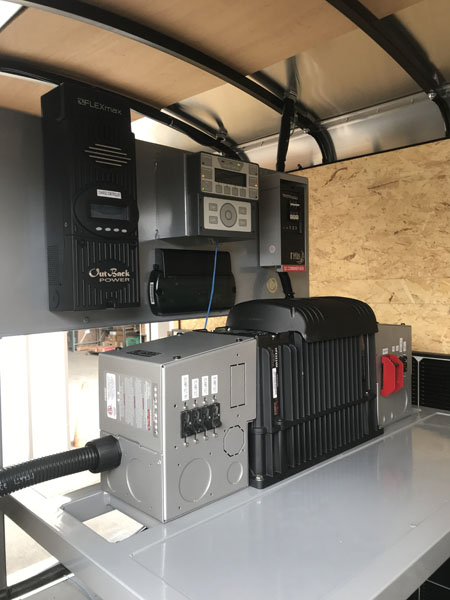
The third driver is operational simplicity. A solar generator for construction sites does not require anyone to drive to the site to check fuel levels. Every Mobile Solar unit ships with a cellular modem that transmits real-time load, output, and usage data to any connected device, and flags issues remotely. The site visit for fuel becomes unnecessary entirely. That is a labor savings and a liability reduction in one.
—
The Clients Who Validated This Technology Early
Understanding which organizations made the switch first helps commercial buyers assess the maturity of the technology. Mobile Solar’s client list reads like a procurement trust index. NASA, the EPA, the U.S. Navy, the U.S. Air Force, the U.S. Army, the USDA, and the Bureau of Land Management are all deployed customers. On the enterprise side: Phillips 66, Verizon, Lockheed Martin, Sierra Nevada Corporation, Parsons (on a 2-plus year military project), Swinerton, Skanska, CBRE, Leidos, and Tetra Tech.
The documented operational benchmark: the U.S. Army ran a mobile solar generator at Fort Irwin for 45 consecutive days of continuous operation. That is not a pilot program. That is a field validation. When organizations at that procurement standard choose a technology and stay with it, commercial buyers have a reliable proxy for maturity and performance. The fact that these clients return and expand deployments rather than revert to diesel is the signal that matters.
—
What 20 Years of Manufacturing Looks Like
Mobile Solar was founded around 2005-2006 by Travis Semmes, who remains President and CEO today. Every unit is designed, engineered, and built in-house in Atascadero, California by a team of engineers, welders, fabricators, and electricians. Mobile Solar is a manufacturer, not a reseller or an importer. That distinction matters when a buyer is assessing warranty coverage, serviceability, and custom configuration capability.
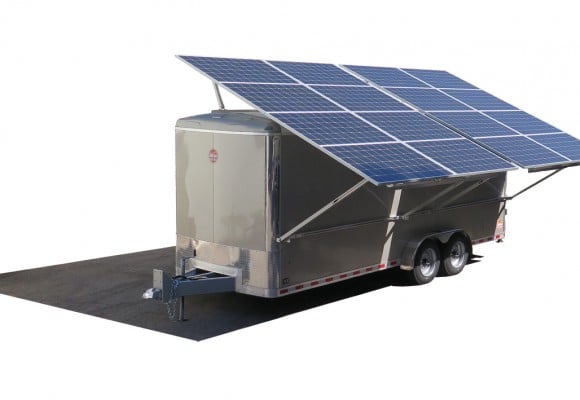
The current lineup spans a range of output classes. The SRX Series uses LiFePO4 lithium iron phosphate batteries and ranges from the SRX-6 (3.6 kW rated, 20.48 kWh) to the SRX-15 (8 kW continuous, 16.97 kW instantaneous, 40.96 kWh). The MS-425, the most popular unit in the MS Series, delivers 16 kW with 60 kWh of storage and can harvest up to 21 kWh per day from its solar array. The M1 steps up to 16 kW rated and 33.94 kW instantaneous, with a 70 kWh battery bank and construction built to military standards for extreme durability. For large supplemental needs, the SA Series arrays add up to 38 kWh of daily harvest capacity without replacing the base unit.
LiFePO4 chemistry, used in the SRX Series, is among the safest and most thermally stable lithium chemistries available. Its iron-phosphate bond structure resists thermal runaway, and it is increasingly preferred for demanding industrial, government, and military applications because of that combination of safety and stability. When operational environments are hard on equipment, chemistry selection matters alongside output specs.
—
Why the Head Start Matters in a Fast-Growing Market
In a market that is projected to triple over the next decade, there is a natural question about which manufacturers are positioned to serve that growth rather than just benefit from it on paper. A trailer mounted solar generator is not a commodity product. Configuration, serviceability, custom build capability, and a track record in demanding deployments are what separate manufacturers from distributors.
Mobile Solar has deployed units across six continents. The company’s custom configuration work is documented: telecom units, LIDAR support, disaster response. Sun For Rent, Mobile Solar’s sister rental company, deployed units during the 2025 Malibu wildfire response when road access and fuel logistics were compromised. That is a use case diesel cannot touch. Fuel delivery to an active fire zone is not viable. A charged, self-contained solar trailer is. Sun For Rent also offers a no-cost 1-week trial in which they tow a unit to a prospect’s job site so the buyer can see performance and savings before committing to a purchase.
For buyers evaluating a diesel generator replacement, the combination of a live trial, a 20-plus-year manufacturing track record, and a client list that includes federal agencies and Fortune 500 contractors represents a procurement path with documented precedent. That is meaningfully different from buying into a growth market with a newer entrant.
—
What the Next Decade Looks Like
The market projections from Intel Market Research, Emergen Research, and Market Research Future describe different slices of the same trend. Portable solar power is moving from specialized application into mainstream commercial infrastructure. The contractors, telecom operators, government agencies, and enterprise facilities managers who adopted early are now the reference points for the ones evaluating the switch today.
The practical case for a commercial solar generator in 2026 is not an environmental argument. It is an operational one. The fuel cost is zero. The maintenance demand is low. The monitoring is remote. The noise and permit friction disappear. And the manufacturer who built the unit is the same company that will support it, because they fabricated every component in California rather than assembling imported parts. For a market on track to roughly triple by 2034, Mobile Solar’s 20-plus-year head start is not nostalgia. It is infrastructure.
For specs on any unit or a custom configuration discussion, reach Mobile Solar at (805) 466-1006 or visit mobilesolarpower.net/contact/.
—
Frequently Asked Questions
Q: How do the different analyst projections for the solar generator market fit together?
A: Different firms define the market differently. Intel Market Research tracks the global solar generator market and projects growth from about $1.89 billion in 2025 to roughly $6.12 billion by 2034. Emergen Research focuses on U.S. portable solar-powered generators specifically and estimates that segment at about $1.5 billion in 2024 growing to about $4.5 billion by 2034. Market Research Future estimates the global market at roughly $2.94 billion in 2025, reaching about $5.56 billion by 2034. All three firms agree that strong growth is underway; the differences reflect scope and methodology, not contradictory findings.
Q: Why is a commercial solar generator a credible diesel replacement rather than just a supplement?
A: Modern commercial solar generators are full-output power plants, not backup devices. Mobile Solar’s MS-425 delivers 16 kW with 60 kWh of battery storage and up to 21 kWh of daily solar harvest, which covers the continuous load demands of most construction, telecom, and remote facility applications. The U.S. Army documented 45 consecutive days of continuous operation at Fort Irwin on a Mobile Solar unit. Supplemental array configurations and optional Honda EU7000 hybrid backup eliminate downtime risk even in low-solar conditions, and cellular remote monitoring means the system is managed without on-site fuel runs.
Q: What makes Mobile Solar different from other solar generator companies entering the market?
A: Mobile Solar designs and builds every unit in-house in Atascadero, California. The company has been manufacturing since approximately 2005-2006, which means its current products reflect two decades of field-driven design iteration rather than first-generation engineering. Its client base includes NASA, the EPA, the U.S. Navy, the U.S. Army, Phillips 66, Verizon, and Lockheed Martin, among others. Those clients have ongoing deployments, not one-off pilots. As a manufacturer rather than a reseller, Mobile Solar also supports custom configurations, offers manufacturer warranties, and provides direct engineering support for complex applications.
—
About Mobile Solar
> Mobile Solar is America’s original mobile solar generator manufacturer, designing and building every trailer mounted solar generator in-house in Atascadero, California for over 20 years. Mobile Solar delivers clean, quiet, fuel-free power for construction sites, off-grid and remote operations, government, and military applications nationwide. Request a quote at mobilesolarpower.net or call (805) 466-1006.
—