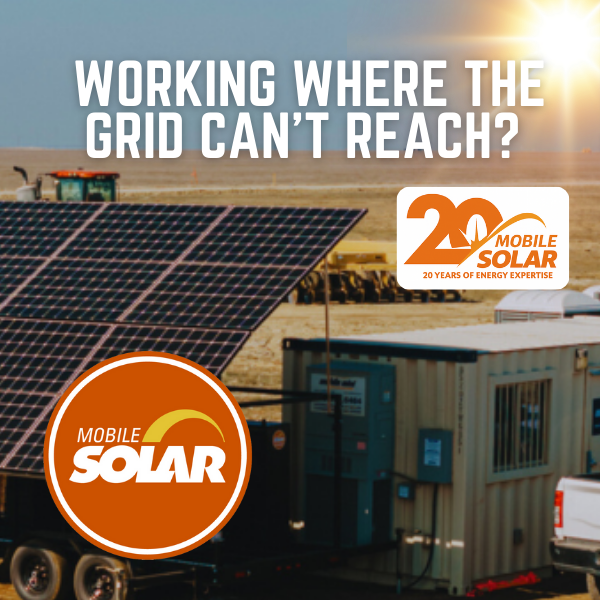


Where Mobile Solar Generators Are Working Right Now
Most conversations about solar power start with rooftops and utility savings. But the units Mobile Solar builds have ended up in places that no rooftop panel could follow: a disaster zone in northern Japan, a windswept ridge where a LIDAR station streams data to engineers in real time, a Los Angeles hillside keeping a telecom tower alive, a dark field in Wisconsin where a retired science teacher shows strangers the Milky Way, and a farm in the mountains of North Carolina where a retired air traffic controller charges his electric car.
These are not hypothetical use cases. They are documented deployments, and each one says something different about what a well-built mobile solar generator is actually capable of.
Disaster Recovery: Northern Japan, 2011
When the 2011 tidal wave struck Japan, the need for power in affected communities was immediate and the grid was not coming back quickly. Mobile Solar loaded seven MS-150 units with tools and shipped them to northern Japan to aid in disaster recovery. The units arrived weeks after the event, as manufacturing and shipping time was unavoidable, but once in place they ran around the clock with no fuel input.
The value of a trailer mounted solar generator in that setting was not just about clean energy. It was about logistics. There was no fuel supply chain to lean on. There were no technicians standing by. The units ran because they were designed to run without those things, and they kept running through the recovery effort. Solar light towers were also deployed as part of the disaster response, providing overnight illumination at work sites where crews were operating in the dark.
That deployment shaped how the company thinks about reliability. A generator that requires fuel resupply or a specialist on call is a liability in a disaster. One that runs on sunlight and asks for almost nothing in return is a different kind of tool.
Wind Energy Research: Remote LIDAR Stations
Wind farm developers need to know where to put their turbines before they commit to construction. That means measuring wind speed at different altitudes, over time, in locations that are often far from roads and well beyond the reach of shore power. Mobile Solar built modified MS-model units specifically for this application, equipping them to power LIDAR systems manufactured by France-based Leosphere.
The off-grid solar generator units are placed in remote locations being evaluated by wind farm developers. They measure wind speed at different altitudes and stream the data to developers in real time, feeding directly into turbine placement decisions. The battery systems are maintenance-free, which matters enormously in this application. Most of the trailers receive a technician visit no more than once per year, and that visit is typically just to wash the solar panels. The systems otherwise operate unattended for more than a year at a stretch.
This is a different kind of remote power requirement than disaster relief. There is no urgency or drama. There is just a need for something that will sit in a field, keep a sensitive scientific instrument running, send data reliably, and ask for almost nothing back. That is a hard brief to fill with a diesel generator. With a properly configured solar system, it becomes routine.
Telecom Infrastructure: Los Angeles Area
Keeping a telecom or data site powered in an urban area might not sound like the kind of challenge that calls for a specialty unit, but the requirements at these sites are real. The load is constant. Interruptions are not acceptable. And running new utility lines to every remote antenna and tower in a dense region is neither fast nor cheap.
Mobile Solar built custom MS-375 units for telecom and data sites in the Los Angeles area. The MS-375 is the largest unit in the MS-Series. Its inverter is rated at 32 kilowatts with surge capacity to 64 kilowatts at 240 volts. The solar array carries 16 mono-crystal photovoltaic modules totaling 4.56 kilowatts DC, with the option to expand to 20 kilowatts DC from SA-24 platforms. Battery capacity sits at 80 kilowatt-hours. Five 80-amp MPPT charge controllers manage the charging side.
For anyone evaluating portable solar power systems for telecom use, the MS-375 represents the upper end of the MS-Series capability. Contact us for specs on configuration details specific to telecom load profiles.
The fact that these units are working inside one of the most infrastructure-dense urban areas in the country is worth noting. The assumption that solar generators are only relevant in remote locations does not hold up when the application is right.
Off-Grid Astronomy: On the Road in Northeast Wisconsin (and Beyond)
John and Brenda Nejedlo have been traveling for approximately one year in a custom trailer rig built around an MS-325 solar system. John is a retired police officer and high school science teacher. The trailer is insulated and features a custom solar panel racking system. Mobile Solar worked with Look Trailers on the custom build. Twelve high-efficiency solar panels and a large battery bank keep the climate-controlled environment inside stable enough to protect sensitive telescope equipment.
The telescopes the Nejedlos bring range up to eight feet tall. Several can connect to TV screens so groups of people can view together. They conduct free astronomy sessions at schools and national parks. They were selected to headline a Family Motor Coach Association rally in Oklahoma. They were also featured in the Epic Nomad TV mini-series, where filmmaker Eric Odom used the trailer to power film equipment.
This is not a use case anyone at a solar trade show would pitch first. But it captures something the other deployments also illustrate: the solar generator trailers built for this kind of work are not niche products solving niche problems. They are platforms. The Nejedlos needed climate control, stable power for optics, and the ability to move. The MS-325 gave them all three, with enough solar capacity to keep going wherever they drove next.
Farm, EV Charging, and Construction: North Carolina
Mark Motto is a retired air traffic controller. He bought an MS-225 in 2014 and has been adding to it ever since, including six additional panels on an auxiliary trailer. He uses it on a 42-acre property in Western North Carolina, and his primary drive is a first generation Nissan Leaf.
He has put an estimated 20,000 miles on the Leaf using energy supplied by the system. On sunny days the unit supports Level 2 charging. On other days it handles Level 1. The unit has been towed over 1,000 miles on long-distance road trips.
The farm applications are less glamorous but no less useful. The MS-225 powers a water heater for livestock during freezing temperatures, provides light and heat for a chicken coop, and handled a 40-foot barn construction project with power tools, outperforming a 5,500-watt gas generator during that build. His advice, offered plainly: “Just as a farmer can never have too big of a tractor, you can never have too much solar.”
For anyone looking at a solar generator for construction site work, Mark’s barn project is a clean data point. The unit was not configured for construction. It was his daily driver’s charger and his farm utility system. It still handled the job.
What These Deployments Have in Common
The settings could not be more different. A disaster zone. A wind research site. An urban telecom tower. A touring astronomy trailer. A mountain farm with an EV in the driveway.
What ties them together is the same thing that shows up in every honest description of these units: they run without being watched, they do not need fuel, and they hold up in conditions that would eliminate most alternatives. The MS-Series covers a range of load sizes, and the custom configuration work Mobile Solar has done for clients like the LIDAR operators and the telecom sites shows that the basic platform can be adapted well beyond its standard configuration.
None of these customers were looking for a story about solar energy. They were looking for emergency backup power, or a reliable data source, or a way to run a farm without a fuel bill, or a way to show a hundred strangers Saturn’s rings from a dark field in Wisconsin. The generator happened to run on sunlight. That turned out to matter.
If you have a power requirement that does not fit a standard category, the M1 solar generator and the full generator line are a reasonable place to start. The company can also be reached directly at (805) 466-1006 or through the contact page.
Frequently Asked Questions
Can a mobile solar generator really run without any fuel or regular maintenance?
Yes. The LIDAR station deployments described in this article show units operating unattended in remote fields for more than a year at a stretch. Technician visits occur roughly once per year, and the visit is typically just to wash the solar panels. The battery systems in these units are maintenance-free.
What is the largest unit in the MS-Series, and what can it power?
The MS-375 is the largest unit in the MS-Series. Its inverter is rated at 32 kilowatts with surge capacity to 64 kilowatts at 240 volts, and it carries an 80 kilowatt-hour battery bank. Custom MS-375 units are currently running telecom and data sites in the Los Angeles area.
Can a mobile solar generator handle EV charging and everyday farm work at the same time?
The MS-225 owned by Mark Motto, a retired air traffic controller in Western North Carolina, has charged his Nissan Leaf for an estimated 20,000 miles. The same unit heats water for livestock during freezing temperatures, powers a chicken coop, and outperformed a 5,500-watt gas generator during a 40-foot barn construction project.
About Mobile Solar
Mobile Solar provides portable solar power systems and solar generator trailers nationwide, delivering clean, quiet, and reliable off-grid power for construction sites, emergency backup, events, and remote locations. Units are designed for ease of transport and quick setup, helping customers reduce noise, emissions, and fuel costs while maintaining consistent power wherever it is needed. Request a quote at mobilesolarpower.net or call (805) 466-1006.