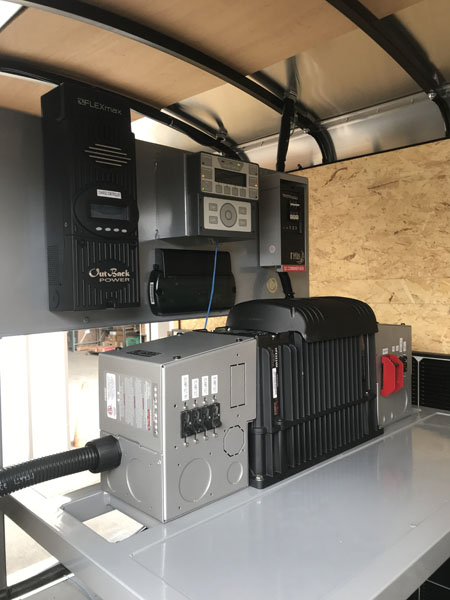


Why Federal and Military Buyers Increasingly Choose LiFePO4 Power
When a government procurement officer evaluates a portable power system, the checklist looks different from a commercial job site. Thermal safety, operational continuity, supply chain independence, and long-term total cost of ownership all carry weight that a simple price-per-kilowatt comparison misses. Lithium iron phosphate chemistry, known as LiFePO4, addresses several of those concerns at the chemistry level. That is why federal agencies and military branches are increasingly choosing LiFePO4-based military solar generator platforms over both diesel generators and older lithium battery chemistries.
What Makes LiFePO4 Different
Not all lithium batteries behave the same under stress. Traditional lithium chemistries, including lithium cobalt oxide and certain nickel-based formulations, carry a recognized risk of thermal runaway. When those cells overheat, degrade, or suffer physical damage, heat accelerates uncontrollably and can lead to fire. In a forward operating base, a disaster recovery site, or a federal facility, that risk is unacceptable.
LiFePO4 chemistry is fundamentally different. The iron-phosphate bond structure is inherently more stable. Energy release during failure is significantly lower, and the chemistry resists the runaway chain reaction that makes other lithium types dangerous. That thermal stability, combined with a longer cycle life compared to most competing lithium chemistries, makes LiFePO4 among the safest options available for demanding off-grid solar generator applications. For government and military buyers managing risk in unpredictable environments, that safety profile matters at the specification stage.
Government and Military Preference Is Growing
No single federal regulation mandates LiFePO4 for all power systems. What is happening instead is quieter and more durable: agencies that have deployed LiFePO4 systems in the field, evaluated their performance over months or years, and compared them to diesel-dependent alternatives are increasingly specifying LiFePO4 on follow-on procurements. The chemistry’s operational advantages line up with what federal buyers are already optimizing for.
Fuel logistics are a persistent vulnerability in remote and austere environments. A diesel generator needs fuel delivered, stored, and tracked. That supply chain is a target and a liability. A solar generator manufacturer USA-built LiFePO4 platform, by contrast, charges from sunlight and requires no fuel convoys. The operational and safety argument writes itself.
Mobile Solar’s Federal and Military Track Record
Mobile Solar has been building trailer-mounted solar generators for government and military clients for over 20 years. The client list includes NASA, the U.S. Navy, the U.S. Air Force, and the U.S. Army. At Fort Irwin, a Mobile Solar unit ran 45 consecutive days of continuous operation, a real-world endurance benchmark in one of the most demanding training environments in the United States. That deployment was not a proof-of-concept test. It was operational power for an extended exercise.
Other federal clients on the commercial solar generator roster include the EPA, USDA, and Bureau of Land Management. Enterprise contractors who serve the federal sector, including Lockheed Martin, Leidos, Sierra Nevada Corporation, Tetra Tech, and Parsons, have also deployed Mobile Solar equipment. Parsons has run a Mobile Solar unit on a military project for more than two continuous years. These are not short-term trials. They reflect sustained confidence in the platform’s durability.
The SRX Series: LiFePO4 Designed for Serious Deployments
Mobile Solar’s SRX series is the company’s LiFePO4-native lineup. The SRX-6 delivers 3.6 kW rated output with 6 kW instantaneous capacity and 20.48 kWh of battery storage, supported by six 375W solar panels. The SRX-9 through SRX-15 step up to 8 kW continuous output with 16.97 kW instantaneous capacity and 40.96 kWh of storage, capable of harvesting 30 to 38 kWh per day in good conditions.
Every unit in the SRX series includes push-button panel deployment, cellular remote monitoring for real-time load and output data from any connected device, and a weatherproof, lockable enclosure. There are no permits required. An optional Honda EU7000 hybrid backup is available for deployments where cloud cover or operational tempo demands a fallback. For agencies that need to scale, supplemental array modules and multi-unit configurations are available. All specifications and configuration options are on the datasheets page.
The M1: Built to Military Standards
Above the SRX series, Mobile Solar’s M1 is built specifically for extreme-durability requirements. It delivers 16 kW rated output, 33.94 kW instantaneous capacity, and 70 kWh of battery storage via twelve 380W panels. The electrical output is 120-240VAC single phase. Mobile Solar builds the M1 to military standards for extreme durability, which is not a marketing phrase but a design requirement reflected in the unit’s construction. Every M1 is designed, engineered, and manufactured in-house at Mobile Solar’s Atascadero, California facility.
For deployments in cold climates, the M1A1 platform is designed to accommodate self-heating LiFePO4 battery technology. A self-heating system maintains cell temperature at approximately 1 to 5 degrees Celsius, allowing safe charging down to about -20 C (-4 F). Standard LiFePO4 cells cannot safely accept charge below freezing. Forcing current into a frozen cell causes lithium plating and permanent capacity loss. The M1A1’s accommodation of self-heating battery technology addresses this limitation directly for cold-weather operations. The M1 solar generator page has additional detail on the platform’s specifications.
Why Solar Changes the Operational Math
Diesel generators are familiar. They are also persistently expensive to operate. By Sun For Rent’s cost analysis, diesel rental runs approximately $1,500 per month per shift and burns roughly one gallon of fuel per hour. That fuel cost is compounded by refueling logistics, oil changes, maintenance labor, and the operational risk of fuel dependency in remote locations.
Mobile Solar units carry zero fuel cost by design. There are no shift charges, no oil changes, no permits, and no noise. The cellular remote monitoring built into every unit means a trailer mounted solar generator can be managed from a phone without sending a technician to the site. In a government environment where every site visit has a cost and every logistics run carries risk, that remote visibility is a genuine operational advantage.
Cold Tolerance and All-Climate Performance
A common concern with solar power in government and military contexts is performance in cold or northern climates. The concern is partly misplaced. Solar panels generate power from light, not from heat. According to data from mobilesolarpower.net, cold temperatures can actually improve panel efficiency, with output reaching up to 110 percent of rated capacity in cold conditions. Net annual output in northern climates is comparable to output in sunnier southern locations when full-year production is considered.
That said, battery charging behavior in freezing temperatures is a legitimate engineering constraint for standard LiFePO4 chemistry. Mobile Solar addresses this at the platform level through the M1A1’s compatibility with self-heating LiFePO4 batteries rather than ignoring it, which reflects the kind of engineering honesty that government buyers tend to reward. For winter operations, Mobile Solar’s published cold-weather guidance covers platform-specific performance in detail.
How the Procurement Conversation Goes
Federal and military buyers evaluating a commercial solar generator for the first time often arrive with questions about uptime guarantees, maintenance obligations, and long-term support. Mobile Solar has been in business for more than 20 years and manufactures every unit in-house. There is no outsourced assembly and no imported-component dependency. Manufacturer warranties are standard. Every unit is serviceable by the team that built it.
Pricing is configuration-specific and quote-based. There is no published price sheet because government and military deployments vary in scale, duration, and site conditions. The right starting point is a conversation about the deployment. To request a quote, contact Mobile Solar at mobilesolarpower.net or call (805) 466-1006.
—
Frequently Asked Questions
Why do government and military buyers prefer LiFePO4 over other lithium battery chemistries?
LiFePO4’s iron-phosphate bond structure resists thermal runaway, making it among the safest lithium chemistries available. For government and military deployments where a battery fire would be operationally catastrophic, that safety profile is a primary selection criterion. LiFePO4 also delivers longer cycle life than many competing chemistries, which reduces total cost of ownership over a multi-year deployment. The combination of safety and durability explains why it is increasingly preferred in demanding government applications.
What makes Mobile Solar’s equipment appropriate for military deployments?
Mobile Solar builds every unit in-house in Atascadero, California, including the M1, which is built to military standards for extreme durability. The company has a documented track record with the U.S. Army (45 consecutive days of continuous operation at Fort Irwin), the U.S. Navy, the U.S. Air Force, and NASA. Equipment is weatherproof and lockable, requires no permits, includes cellular remote monitoring, and carries manufacturer warranties. A Parsons-managed military project has run a Mobile Solar unit continuously for over two years.
Can a LiFePO4 solar generator operate in cold-weather environments?
Solar panels function well in cold weather and can actually produce up to 110 percent of rated output at low temperatures because efficiency improves in the cold. The engineering constraint is battery charging: standard LiFePO4 cells cannot safely accept charge below freezing. Mobile Solar addresses this on the M1A1 platform through compatibility with self-heating LiFePO4 battery technology, which uses a self-heating system to maintain cell temperature down to approximately -20 C (-4 F) and allow safe cold-weather charging.
—
About Mobile Solar
> Mobile Solar is America’s original mobile solar generator manufacturer, designing and building every trailer mounted solar generator in-house in Atascadero, California for over 20 years. Mobile Solar delivers clean, quiet, fuel-free power for construction sites, off-grid and remote operations, government, and military applications nationwide. Request a quote at mobilesolarpower.net or call (805) 466-1006.
—