

Key Mobile Solar Power Terms, Explained
If you have been researching solar generators and found yourself stumbling over words like MPPT, SOC, or photovoltaic, you are not alone. The field has its own shorthand, and a lot of it gets thrown around without much explanation. This glossary pulls directly from how Mobile Solar actually uses these terms across its product pages and project write-ups. Each entry is defined in plain English so you can read a spec sheet, ask better questions, and make a more confident decision.
The Power Components
Inverter and Surge Rating
An inverter is the device inside a solar generator that converts the DC electricity stored in the batteries into the AC electricity that powers standard tools, appliances, and equipment. The rated output tells you how much continuous power the unit can deliver. The surge rating is the higher, short-burst figure the inverter can handle when a motor or compressor first starts up. Mobile Solar’s MS-375, for example, carries a rated inverter output of 32 kW and can surge its 240-volt power to 64 kW. When comparing units, both numbers matter because tools with electric motors draw far more current at startup than they do while running. You can review current inverter specs for each MS-Series model on the product pages.
MPPT Charge Controller
MPPT stands for Maximum Power Point Tracking. A charge controller sits between the solar panels and the battery bank and manages how electricity flows from one to the other. An MPPT controller is the more efficient type because it continuously adjusts the electrical operating point of the panels to extract as much energy as possible under changing light conditions. The MS-375 telecom builds used five 80-amp MPPT charge controllers to handle up to 20 kW DC from multiple solar generator trailers feeding into the system. The more panels a system has, the more charge controller capacity is needed to keep them all working at full output.
Photovoltaic (PV) Module and Mono-Crystal Panel
A photovoltaic module, commonly called a solar panel, is the unit that converts sunlight into DC electricity. The word photovoltaic describes the process: light (photo) striking semiconductor material creates a voltage (voltaic). Mono-crystal, or monocrystalline, refers to the way the silicon in the panel is manufactured, and it is associated with higher efficiency compared to other panel types. Mobile Solar’s MS-375 builds each included 16 mono-crystal photovoltaic modules rated at 285 watts per panel, producing 4.56 kW DC from the roof array alone. Each mobile solar power system is built around a specific panel configuration chosen for the unit’s intended output and physical footprint.
Arrays and Battery Systems
Solar Array and the SA-24
A solar array is simply a collection of photovoltaic modules wired together to produce more power than a single panel could on its own. Mobile Solar also manufactures a standalone product called the SA-24, which is a rolling photovoltaic array on its own platform. In the MS-375 telecom builds, five SA-24 arrays were deployed alongside the roof panels to push available DC input up to 20 kW. These rolling arrays give operators the ability to expand generating capacity at a site without replacing the core trailer unit. Learn more about portable solar power systems that can be paired with additional array capacity.
Battery Bank and Amp-Hours at 48VDC
The battery bank is the storage system inside a solar generator. When the sun is not shining, or when demand spikes above what the panels can produce in real time, the battery bank supplies the power. Battery capacity is measured in kilowatt-hours (kWh) or in Amp-Hours (Ah) at a stated voltage. The MS-375 carries 1,673 Amp-Hours at 48 volts DC at the 20-hour discharge rate, which works out to 80 kWh of storage. The 48VDC figure is the system voltage, a common standard for larger battery banks because it keeps current levels manageable at high power outputs. Each battery bank in that build weighed close to 6,000 pounds, which gives a sense of the scale involved in high-capacity off-grid solar generator configurations.
Energy Accounting
kWh and State of Charge (SOC)
A kilowatt (kW) is a measure of power, meaning how fast energy is being used or produced at a given moment. A kilowatt-hour (kWh) is that same power delivered over one hour. The distinction matters when evaluating a system: a generator might have a 25 kWh battery and a 9 kWh-per-day solar harvest. State of Charge (SOC) is the percentage of usable battery capacity remaining at any given moment, working like a fuel gauge. Mobile Solar’s recharge guidance uses the MS-225 as an example: drain 80 percent of a 25 kWh bank, and you use 20 kWh. Recharge time depends on daily solar harvest. You can request specs for any specific M1 solar generator or MS-Series build by contacting the team directly.
Daily Solar Harvest
Daily solar harvest is the amount of energy, measured in kWh per day, that the solar panels on a given unit can realistically collect under average conditions at a site. It accounts for panel rating, hours of useful sunlight, and real-world efficiency. Mobile Solar uses it directly in the recharge calculation: divide the kWh of battery capacity you have used by the daily solar harvest to find out how many days of solar charging are needed to return to full SOC. The MS-225, for instance, carries a daily harvest of 9 kWh per day. This figure also helps operators plan around cloudy stretches or high-demand days without being caught short. For site-specific harvest estimates, contact the team at mobilesolarpower.net.
System Modes and Configurations
Off-Grid
Off-grid means operating without any connection to the utility power grid. A mobile solar system running off-grid generates its own electricity from the sun, stores it in batteries, and supplies it to the loads connected to the unit with no dependence on external infrastructure. Mobile Solar builds its equipment for permanent off-grid use in applications ranging from remote construction and oil and gas sites to agricultural operations and research deployments. Mark Motto, for example, ran an MS-225 entirely off-grid to power his farm and charge his electric vehicle without drawing from the grid. For a look at off-grid applications in commercial settings, see the solar generator for construction site page.
Gas and Diesel Hybrid Backup
Some Mobile Solar units can be configured with an optional gas or diesel hybrid backup. This means a fuel-burning generator is incorporated as a secondary power source that can charge the battery bank or supplement output when solar harvest falls short, such as during extended overcast periods or unusually high-demand situations. The M1 is specifically described as offering optional gas/diesel hybrid backup for operators who want extra redundancy. This configuration is not the default mode of operation. It is a safeguard for sites where the consequences of a power gap are severe enough to justify keeping a fuel source on standby. Contact Mobile Solar for details on which trailer mounted solar generator configurations support hybrid backup.
Specialty Products
LIDAR
LIDAR stands for Light Detection and Ranging. In the context of Mobile Solar’s enterprise builds, LIDAR units are instruments mounted on modified MS-model trailers that measure wind speed at different altitudes by sending out light pulses and reading what comes back. These sensor-equipped trailers are placed in remote locations for extended periods, sometimes more than a year, by wind farm developers who need to characterize wind resources before placing turbines. The Mobile Solar platforms power the LIDAR equipment and stream data in real time without requiring regular service visits. Because the batteries are sealed and maintenance-free, a technician may visit a unit no more than once a year. This is one of the more specialized remote power applications in the Mobile Solar catalog.
Solar Light Tower
A solar light tower is a portable lighting unit powered by solar energy rather than a diesel engine. Mobile Solar references solar light towers in the context of disaster recovery, noting them alongside compact solar generators as rugged, utility-independent products suited to situations where lives depend on reliable power. A solar light tower provides area lighting without fuel, without noise, and without exhaust, making it practical for emergency response, construction night shifts, and remote worksites. For current availability and configurations, contact Mobile Solar at mobilesolarpower.net or call (805) 466-1006.
Sealed Electric Generator
Mobile Solar also manufactures what it describes as sealed electric generators, offered as an additional product alongside its solar trailer line. The site notes these units carry “extreme versatility” and are listed as an option that can complement a solar trailer setup. Specific output ratings and configurations are available on request. For current specs and compatibility with existing emergency backup power systems, reach out to the Mobile Solar team directly.
Solar Generator Trailer and Mobile Solar Trailer
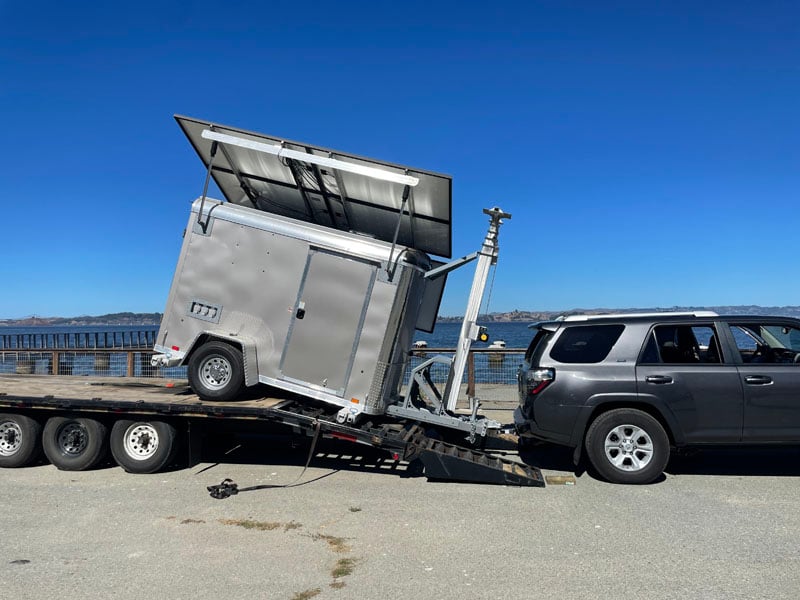
These two terms are often used interchangeably and describe the same core product: a self-contained solar power system built into a towable trailer. The system includes the photovoltaic panels, battery bank, charge controllers, and inverter in one unit that can be hitched to a standard pickup truck and deployed without special equipment or permits. Mobile Solar builds its trailers to be weatherproof and lockable, with enough interior space in some configurations to store additional equipment. The MS-225, MS-325, MS-375, and M1 are all solar generator trailers at different scales, from compact camping and farm use to heavy industrial and telecom deployments. The full lineup is listed on the solar generator trailers page.
—
These terms come up constantly in conversations about mobile power, and knowing what they mean makes every part of the buying process easier. Whether you are comparing battery capacity, thinking through recharge time, or figuring out whether hybrid backup fits your site, the numbers start to tell a clear story once the vocabulary is in place. If a specific spec is not published on the site, the team at Mobile Solar is the right place to ask.
Frequently Asked Questions
What is the difference between rated inverter output and surge capacity?
Rated output is the continuous power an inverter can deliver during normal operation. Surge capacity is the higher, short-burst figure the inverter can handle when a motor or compressor first starts up. The MS-375, for example, carries a rated inverter output of 32 kW and can surge its 240-volt power to 64 kW. Both numbers matter because tools with electric motors draw far more current at startup than they do while running.
How do I calculate how long it takes to recharge my solar generator battery bank?
Divide the kilowatt-hours you have drawn from the battery by the unit’s daily solar harvest figure to find the number of days of solar charging needed to return to full State of Charge. The MS-225 provides a clear example: drain 80 percent of a 25 kWh bank (20 kWh used) with a daily harvest of 9 kWh per day, and recovery takes about 2.2 days of sun. For site-specific harvest estimates, contact the team at mobilesolarpower.net.
Can a mobile solar trailer run off-grid permanently, without any grid connection?
Yes. Mobile Solar builds its equipment for permanent off-grid use, meaning the system generates its own electricity from the sun, stores it in batteries, and supplies it to connected loads with no dependence on external utility infrastructure. Applications range from remote construction and oil and gas sites to agricultural operations. For operators who need extra redundancy, some units can be configured with an optional gas or diesel hybrid backup as a secondary power source.
About Mobile Solar
Mobile Solar provides portable solar power systems and solar generator trailers nationwide, delivering clean, quiet, and reliable off-grid power for construction sites, emergency backup, events, and remote locations. Units are designed for ease of transport and quick setup, helping customers reduce noise, emissions, and fuel costs while maintaining consistent power wherever it is needed. Request a quote at mobilesolarpower.net or call (805) 466-1006.