

Quiet, Permit-Free Power: A Job-Site Compliance Field Guide
Every project manager who has run a diesel generator on a public job site knows the routine. The complaints start before 7 a.m. A neighbor calls the city. The inspector shows up asking about permits. The fuel truck is late, and half the crew is standing around. None of that has anything to do with the scope of work. It is the cost of keeping the lights on with old technology. A solar generator for construction sites eliminates most of that friction at the source.
Why Diesel Generators Create Compliance Problems
Diesel generators are loud. Depending on the model and load, a running diesel unit can be about as loud as a busy highway at close range. That puts them in direct conflict with noise ordinances that exist in most cities and many counties, ordinances that frequently set limits well below that threshold during business hours and drop those limits sharply in the evening.
The noise issue is only the first compliance layer. Many municipalities require permits for temporary generators above certain output thresholds, particularly on commercial job sites near residential areas. The permit process delays project starts, adds paperwork, and creates inspection checkpoints that slow down mobilization. Contractors who have navigated that process more than once tend to look hard at alternatives.
Emissions add a third pressure point. Diesel exhaust contains particulate matter and nitrogen oxides. In states with active air-quality management districts, using a diesel generator on a construction site can trigger emissions reporting requirements or outright restrictions during high-ozone alert days. For job sites in urban cores or near schools, the regulatory exposure compounds quickly.
The Compliance Math on a Solar Unit
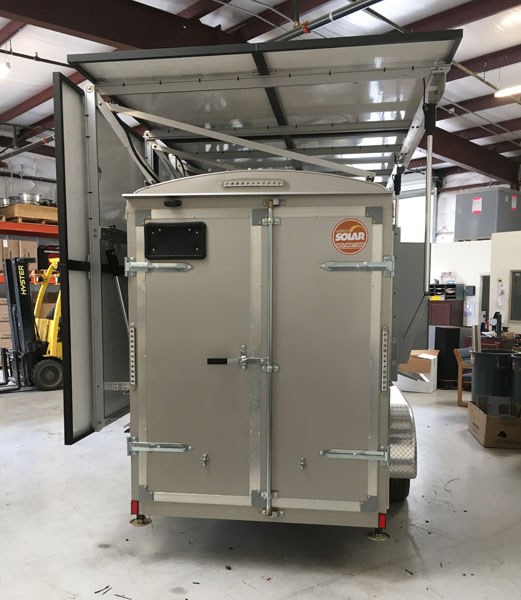
A trailer mounted solar generator produces no combustion noise and no exhaust. Operating sound comes from the inverter fans and any ancillary equipment connected to it, not from the unit itself. That means it operates well within typical noise ordinance limits without any accommodation. Night operations, weekend work, and sites adjacent to residential neighborhoods all become significantly simpler to manage.
Emissions requirements largely disappear. No combustion means no particulate output, no NOx, and nothing to report to an air-quality management district. On projects in regulated airsheds, that is a concrete risk reduction, not a theoretical one. The project proceeds without scheduling around alert days or seeking variance approvals.
On the permit question, Mobile Solar units require no permits to deploy. Push-button panel deployment means the unit is operational in minutes after it arrives on site. Visiting the generator product lineup shows configurations from the 3.6 kW SRX-6 up to the 16 kW MS-425, the most popular model, all carrying that same no-permit characteristic regardless of output.
What “Silent Operation” Actually Means on a Job Site
Silence is not a small thing. On a site near residential neighbors or inside a mixed-use development, noise complaints can halt work through code enforcement, generate fines, and damage relationships with the community the project team is trying to work alongside. A mobile solar generator running quietly during early-morning pour prep or late-afternoon finishing work simply does not register on a noise meter the way a diesel unit does.
The downstream effects matter too. Crews work more comfortably without constant engine noise. Communication on site is easier. Supervisors can hear what is happening across the site without walking up to someone and yelling. None of this shows up on a compliance checklist, but experienced superintendents consistently list it as a quality-of-life improvement that affects retention.
Fuel Logistics as a Compliance Risk
Diesel fuel delivery to an urban job site is a logistics and liability exposure that solar eliminates entirely. Fuel trucks need access windows, secondary containment in some jurisdictions, and documentation if a spill occurs. On tight city blocks or in environmentally sensitive areas near waterways, those requirements add overhead that a diesel generator replacement strategy can eliminate completely.
By Sun For Rent’s estimates, diesel rental runs roughly $1,500 per month per shift and burns about one gallon per hour. Fuel cost, spill liability, and access coordination all stack on top of that baseline. A solar alternative carries $0 fuel cost and $0 shift charges. Those savings are real, but the compliance simplicity is often the more important number for project managers trying to keep a schedule.
Remote Monitoring and the Inspector Question
One argument that comes up in contractor evaluations is documentation. Inspectors and clients sometimes ask for power usage logs, particularly on government projects or jobs with sustainability reporting requirements. Every Mobile Solar unit includes a cellular modem for real-time load, output, and usage data accessible from any device, plus remote diagnostics. That data trail answers the documentation question without any manual recordkeeping.
The monitoring capability also changes how site power gets managed. An operator can check state of charge, current draw, and panel output from a phone or laptop without driving to the site. On multi-site deployments, that remote visibility eliminates the fuel-check site visits that diesel requires, which reduces both cost and the vehicle traffic that itself can create compliance issues on congested urban project sites.
Choosing the Right Configuration for Your Load Profile
The compliance benefits are constant across the lineup, but matching output to load profile is where the engineering conversation starts. The MS-225 at 8 kW continuous handles lighting, compressors, and small tools for a mid-size crew. The MS-425 at 16 kW rated output with 60 kWh of battery storage handles larger demands and carries enough reserve to power through overcast periods without interruption.
For projects with supplemental power needs or unusual site layouts, the SA supplemental array series can expand daily harvest. The SA-12 adds roughly 30 kWh per day, and the SA-15 adds about 38 kWh per day. Multiple units can run in parallel for large projects. Pricing is quote-based per configuration because site conditions, load profiles, and duration vary enough that a single posted rate would not be useful.
The Government and Enterprise Standard
It is worth noting that the compliance argument has already been validated at scale. Mobile Solar’s client list includes the EPA, the U.S. Army at Fort Irwin (45 consecutive days of documented continuous operation), NASA, the U.S. Navy, the U.S. Air Force, and enterprise contractors Swinerton, Skanska, and Parsons, among others. These are organizations with procurement standards and compliance requirements far more demanding than a typical commercial job site. They chose solar power trailers for their projects.
The commercial construction market is arriving at a conclusion those clients reached earlier. Noise ordinances are tightening. Emissions rules are expanding in urban markets. Permitting delays cost money. A commercial solar generator that sidesteps all three compliance layers simultaneously is not a nice-to-have for the next decade. It is a current-cycle operating decision for project teams trying to hold their schedules and protect their margins.
Starting the Transition
Sun For Rent, Mobile Solar’s rental affiliate, offers a no-cost one-week job-site trial. They tow the unit to the site so the project team can measure actual performance against their load profile before making a purchase decision. That removes the evaluation risk entirely. See the full lineup at mobilesolarpower.net or call (805) 466-1006 to discuss configuration options for an upcoming project.
—
Frequently Asked Questions
Do solar generators require any permits to operate on a job site?
Mobile Solar units require no permits to deploy or operate. Because they produce no combustion emissions and operate without engine noise, they do not trigger the permit requirements that many municipalities attach to diesel generators above certain output thresholds. Push-button panel deployment means the unit is generating power within minutes of arrival on site.
How do solar generators handle noise ordinance compliance?
A solar power trailer produces no combustion engine noise. Operating sound is limited to inverter fans and connected equipment, which falls well within typical municipal noise ordinance limits. That means early-morning, evening, and weekend operations near residential areas or in mixed-use neighborhoods proceed without the complaints and code enforcement issues that diesel units routinely generate.
Can a solar generator replace a diesel unit in terms of output for a real construction site?
Yes, for a broad range of commercial load profiles. The MS-425, Mobile Solar’s most popular model, delivers 16 kW rated output with 60 kWh of battery storage and up to 21 kWh of daily solar harvest. It handles lighting, compressors, power tools, and site office equipment simultaneously. Larger loads can be met by adding supplemental SA arrays or running multiple units in parallel. Request a quote at mobilesolarpower.net/contact with your load profile for a configuration recommendation.
—
About Mobile Solar
> Mobile Solar is America’s original mobile solar generator manufacturer, designing and building every trailer mounted solar generator in-house in Atascadero, California for over 20 years. Mobile Solar delivers clean, quiet, fuel-free power for construction sites, off-grid and remote operations, government, and military applications nationwide. Request a quote at mobilesolarpower.net or call (805) 466-1006.
—